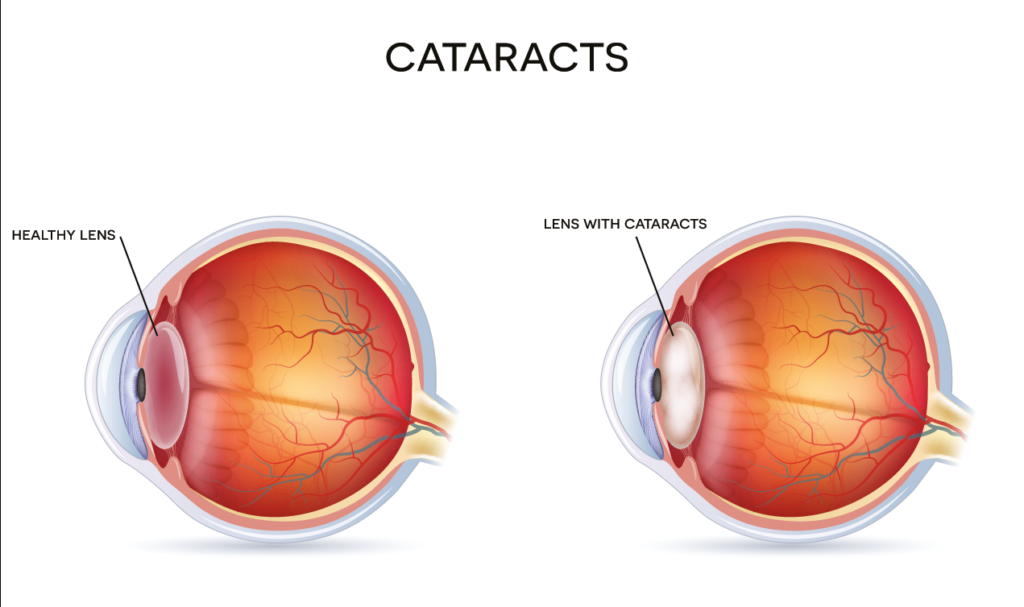

If you are preparing for cataract surgery, the question of monofocal vs multifocal lenses will come up sooner or later. During the procedure, your clouded natural lens is replaced with an artificial intraocular lens (IOL), and the type you choose has a direct impact on how you see afterwards. At Oogcentrum Medipolis in Wilrijk, on the southern edge of Antwerp, we discuss this with patients every single day.
Below are the questions we hear most often, each with a short answer first and the explanation after it.
Monofocal vs multifocal lenses: what is the difference?
In one sentence: a monofocal lens gives you sharp vision at one distance, a multifocal lens at several distances.
A monofocal IOL has a single focal point. Your ophthalmologist sets it for either distance or near vision, and that setting is permanent. A multifocal IOL contains several optical zones that focus light from near, intermediate (think of a computer screen) and far onto the retina at the same time. The result is that you can see clearly at multiple distances without constantly hunting for a pair of glasses.
Will I still need glasses with a monofocal lens?
Usually, yes. If your lens is set for distance, you will need reading glasses for the newspaper or your phone. If it is set for near, you will wear glasses to drive or watch television.
Most people go for clear distance vision, which makes driving, recognising faces and watching TV easier. The strength of a monofocal lens is the quality of the image at that one distance: crisp, with good contrast, even in dim conditions. It is the most widely implanted lens type in the world and has been a dependable choice for decades.
Can I go completely glasses-free with a multifocal lens?
Largely, in many cases, but not always entirely. Many patients with multifocal lenses in both eyes manage everyday life without glasses: reading, cooking, working at a screen, playing sport. For very small print or in poor light, a light pair of readers may occasionally still be handy.
The main benefit is convenience. You move from one task to the next without swapping spectacles. For active people who value independence from glasses, that can be a genuine improvement in quality of life.
What are the downsides of a multifocal lens?
Halos around lights and slightly reduced contrast in the dark. Because the incoming light is split across several zones, some people notice rings around street lamps or headlights at night. The brain generally adapts, but this takes time, a process known as neuroadaptation.
In low light, contrast can be a little lower than with a monofocal lens. Good lighting when you read is advisable in any case. If you drive a lot at night or work in a job where fine contrast matters, discuss this thoroughly with your ophthalmologist.
What is monovision, and is it right for me?
Monovision means one eye is corrected for distance and the other for near, each with a monofocal lens. That gives you functional vision at both ranges without a multifocal implant.
It is a well-established approach. The trade-off is reduced depth perception: judging distances or catching a moving ball can be trickier at first. There is also an adjustment period, since each eye sees differently, and some people notice glare at night. That is why at Oogcentrum Medipolis we first simulate monovision with contact lenses or trial glasses to check that your brain is comfortable with it.
What does health insurance cover in Belgium?
Standard cataract surgery with a monofocal lens is largely reimbursed through the Belgian health insurance system (mutualité/ziekenfonds). If you opt for a premium lens, such as a multifocal or a toric lens (which also corrects astigmatism), you pay a supplement yourself.
The size of that supplement depends on the lens type and your individual situation. You will receive clear information about it during your consultation, before you make any decision.
How do I choose between the cataract lens options?
By looking at your eyes and your lifestyle together with your ophthalmologist. Weighing up cataract lens options is not something you do alone. At your consultation we measure your eyes, review your prescription and check for any other eye conditions, and we talk about what you do day to day.
Do you read a lot? Do you drive frequently, including after dark? Do you spend hours at a screen, or are you often outdoors playing sport? All of that matters. Not every lens suits every eye, either: with certain retinal or corneal conditions, your ophthalmologist will advise against a multifocal implant. In the end, the decision is made together, based on what is most sensible for you.
Still undecided about monofocal vs multifocal lenses? Book a consultation at Oogcentrum Medipolis on Boomsesteenweg in Wilrijk, Antwerp. Our team, used to welcoming international patients, will examine your eyes and walk you through every option calmly, so you can make a choice that fits the way you live and see.